
Most people don’t dread the filling itself. They dread not knowing what will happen: the needle, the drill, how long they’ll be in the chair, and how the tooth will feel afterward. Knowing the sequence takes much of that worry away.
This guide walks through the full dental filling procedure from the first X-ray to the final bite check, explains what you will and won’t feel, and covers the first two days afterward, when most questions come up.
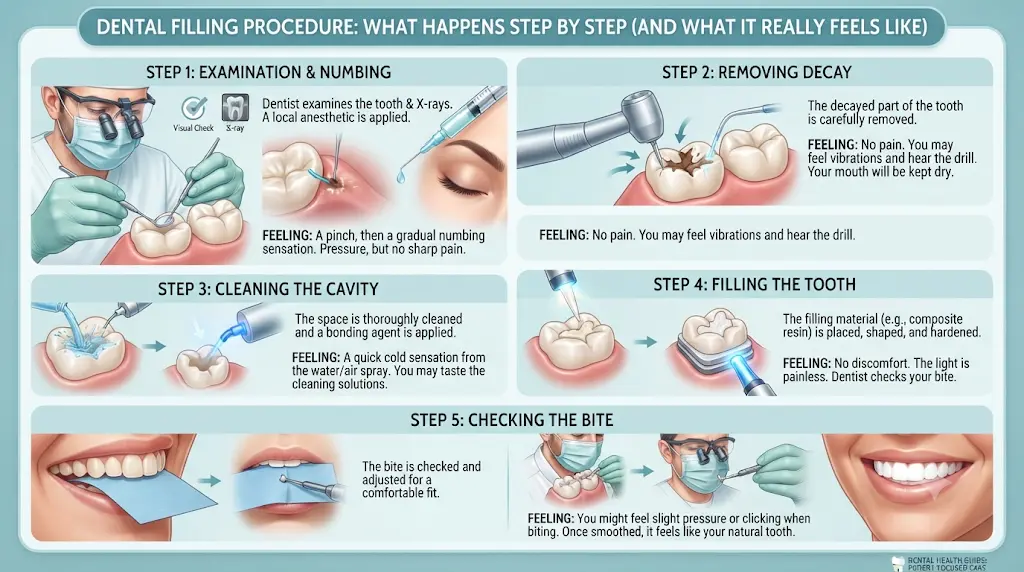
What Happens During a Dental Filling?
A dental filling takes about 30 to 60 minutes for a single tooth. Your dentist numbs the area, removes the decayed part of the tooth, cleans and prepares the space, places the filling material, shapes and polishes it, then checks your bite. You’ll feel pressure and vibration but should not feel sharp pain. The numbness usually wears off within a few hours.
That is the short version. Here is each step in order.
The Dental Filling Procedure, Step by Step
Step 1: Examination and X-Ray
Before any treatment, your dentist confirms that a filling is the right solution. They examine the tooth, check how far the decay extends and usually review an X-ray, because decay between teeth or under the surface isn’t always visible. The X-ray also shows how close the decay is to the nerve, which affects how the rest of the visit goes.
This is also the time to tell your dentist about allergies, medications, previous reactions to anaesthetic and any anxiety about treatment. If a tooth has been aching, mention when and how, since lingering or night-time pain can point to something deeper than a simple cavity. (Our post on why a toothache gets worse at night explains why.)
Step 2: Numbing the Area
Many dentists start with a topical numbing gel on the gum, so the injection feels less sharp. Then they inject a local anaesthetic near the tooth. Expect a brief pinch and a feeling of pressure for a few seconds. Within a few minutes the tooth, nearby gum and often your lip and cheek feel thick or “asleep.”
The dentist will check that you’re numb before starting. If you can still feel something, say so. It is easy to give a little more, and it’s much better than trying to tough it out.
Step 3: Isolating the Tooth
The dentist keeps the tooth clean and dry using cotton rolls, suction and sometimes a small rubber sheet called a dental dam. This isn’t just for comfort. Most modern filling materials bond to the tooth and need a dry surface to hold properly, so this step helps the filling last.
Step 4: Removing the Decay
Next, the dentist removes the softened, decayed part of the tooth with a dental handpiece (the “drill”). Some clinics may also use a laser or air abrasion for certain cavities, depending on their equipment and the case. The goal is to remove the decay while keeping as much healthy tooth as possible.
This is the step people expect to hurt, but because the area is numb, you’ll mostly notice vibration, pressure and the sound. The noise often feels worse than the sensation. If you’re bothered by it, ask about headphones or music.
Step 5: Cleaning and Preparing the Space
Once the decay is gone, the dentist rinses and cleans the cavity and shapes it so the filling can sit securely. For a tooth-coloured composite filling, the surface is conditioned and a bonding agent is applied so the material sticks to the tooth. If the decay was very deep and close to the nerve, a thin protective lining may be placed first.
Step 6: Placing the Filling
The way the filling goes in depends on the material:
- Composite resin (tooth-coloured): Placed in thin layers. Each layer is hardened with a blue curing light for a few seconds, and the material is sculpted to match the tooth’s natural shape. It is fully set when you leave the chair.
- Glass ionomer: A tooth-coloured material that bonds to the tooth and releases some fluoride. It’s often chosen in lower-pressure areas or for certain baby teeth.
- Amalgam (silver): Packed into the cavity and shaped as it sets. It can take about a day to reach full strength, so your dentist may ask you to go easy on that tooth.
Which one is best for your tooth depends on the size and position of the cavity, your bite and your preferences. Our guide to the types of dental fillings compares the options in detail.
Step 7: Shaping, Polishing and Checking Your Bite
When the filling is in place, the dentist trims any excess and polishes it smooth. Then comes a step many people don’t know about: the bite check. You’ll bite down on thin coloured paper that marks any spot where the filling touches too hard. If the filling sits even slightly high, the dentist adjusts it.
While you’re still numb it can be hard to judge how your teeth meet. If your bite feels “off” once the numbness fades, call and ask for a quick adjustment. It’s a simple fix.
Does Getting a Filling Hurt?
For most people, a filling is not painful, but it isn’t sensation-free either. Here’s what’s typical:
- The injection: a short pinch or sting, softened by numbing gel.
- During treatment: pressure, vibration, water spray and noise, but not sharp pain.
- Deep cavities: can be more sensitive, and a tooth with significant inflammation can be harder to numb. Your dentist may give extra anaesthetic.
The one rule: sharp pain during treatment is not something to put up with. Raise your hand and tell your dentist.
If You’re Anxious About Dental Treatment
Dental anxiety is common, and it’s worth mentioning before the appointment, not after. Your dentist can explain each step as it happens, agree on a hand signal to pause, and discuss comfort options. For stronger anxiety, ask about sedation dentistry, which can make longer or more involved visits far easier.
How Long Does a Filling Take?
A single, straightforward filling commonly takes about 30 to 60 minutes, including numbing time. Several things change that:
| Factor | Effect on appointment length |
|---|---|
| One small surface cavity | Often at the shorter end |
| Large or deep cavity | Longer; more careful work near the nerve |
| Several fillings in one visit | Longer, and sometimes split into two appointments |
| Hard-to-reach back tooth | Slightly longer |
| Replacing an old filling | Similar, or a bit longer if old material must be removed |
| Children | Often similar, but keeping little ones comfortable can add time |
If your dentist recommends treating several teeth, ask whether they would do them in one visit or spread them out. Smaller appointments are easier on your jaw.
What to Expect After a Filling: The First 48 Hours
Numbness
Local anaesthetic typically wears off within a few hours, though it can last longer, especially on lower teeth. Until it does:
- Avoid chewing on the numb side. It’s easy to bite your cheek, lip or tongue without feeling it.
- Be careful with hot drinks, since you can’t judge the temperature.
If you were only given local anaesthetic (no sedation), most people can go back to work or normal activities right away. The timing of your first meal depends on the material and on when the numbness fades. Our guide to how long to wait before eating after a filling covers that in detail.
Sensitivity
Some sensitivity to hot, cold, sweet foods or biting pressure is common for a few days, and it can linger a little longer after a deep filling. It should gradually improve. Helpful habits include:
- Brushing gently with a soft brush and fluoride toothpaste
- Avoiding very hot, very cold or sugary foods for a few days
- Using a toothpaste made for sensitive teeth if your dentist suggests it
- Keeping up flossing, which also prevents new decay beside the filling
When to Call Your Dentist
Call if you notice any of these:
- Pain that gets worse instead of settling after a few days
- A bite that feels high or uneven
- Throbbing or spontaneous pain, especially at night
- A sharp or rough edge that irritates your tongue or cheek
- A filling that cracks, chips or falls out
Pain that keeps building or doesn’t fade can mean the nerve is irritated, and sometimes a deeper treatment such as a root canal is needed. Swelling, a fever, or severe pain needs prompt attention, so see our page on emergency dentistry or call the office.
Is a Filling Always the Right Treatment?
Not always. A filling is ideal for small to moderate decay or minor damage. When a tooth has lost a lot of structure, other treatments may protect it better:
- A inlay or onlay can suit a cavity too large for a regular filling but not large enough to need a full crown.
- A dental crown covers and protects a tooth that is badly weakened or cracked.
- A root canal is needed if decay or infection has reached the nerve.
Fillings also don’t last forever. If you’re wondering whether an old one is due for replacement, read our guide to signs a filling needs replacing, and for the long view see how many times a tooth can be filled.
Filling a Child’s Tooth
Cavities in children are more common than many parents expect, and baby teeth are worth treating because they hold space for adult teeth and affect eating and speech. The steps are the same, but the dentist focuses on keeping the visit short and calm. If you’re worried about a young child’s cavities, read is it normal for a 4-year-old to have cavities or learn more about pediatric dentistry in Abbotsford.
How to Prepare for Your Filling Appointment
A little preparation makes the visit smoother:
- Eat beforehand, since you may not want to chew for a few hours afterward.
- List your medications and allergies for the dentist.
- Tell the team if you’re anxious, so they can plan around it.
- Plan your day so you don’t need to eat a big meal or speak publicly while you’re numb.
- Check your benefits. Many plans cover fillings, and it’s worth confirming your coverage and any year-end deadlines. Our post on using your dental benefits before the end-of-year deadline can help.
Frequently Asked Questions
Do you get numbed for a filling?
Yes, in most cases. The dentist usually uses a local anaesthetic so the tooth and surrounding area are numb. For a very small, shallow cavity, some patients can have treatment with little or no anaesthetic, but this is your dentist’s call.
How long does a dental filling take?
A single filling usually takes about 30 to 60 minutes. Large, deep or multiple fillings can take longer.
Can I drive after a filling?
If you only had local anaesthetic, most people can drive normally. If you had sedation, you’ll need someone to take you home. Ask your dentist beforehand.
How long does the numbness last after a filling?
Usually a few hours, and sometimes longer on lower teeth. Avoid chewing on the numb side until normal feeling returns.
Is it normal for a tooth to hurt after a filling?
Mild sensitivity to temperature or pressure for a few days is common. Pain that is severe, worsening, or keeps you up at night should be checked.
Why does my bite feel uneven after a filling?
The filling may be slightly high. This is common and easy to correct with a quick adjustment, so call the office rather than waiting for it to “wear in.”
Book a Filling Consultation in Abbotsford
If you’ve noticed a cavity, sensitivity to sweets or cold, or a rough spot on a tooth, an early filling is usually simpler than waiting. Our team at Medora Dental Care can examine the tooth, explain your options and walk you through each step so there are no surprises. Learn more about dental fillings in Abbotsford, then call (604) 746-1295 or contact us to book. We’re at 110-1910 N Parallel Rd, Abbotsford, BC.
This article is general information, not personal dental advice. Your dentist can assess your own situation.