
If you’ve been told you need a “permanent” bridge, it’s fair to wonder what that word promises. Will it stay in for life? Can it come out? Does it stain like natural teeth? Patients in Abbotsford ask us these questions all the time, usually right before they commit to treatment.
The short version: a dental bridge is permanent in the sense that you can’t take it out yourself, but it isn’t permanent in the sense of lasting forever. This guide explains the difference, what’s normal in the first few weeks, and how to handle two everyday concerns that rarely get a clear answer: stains and mouthwash.
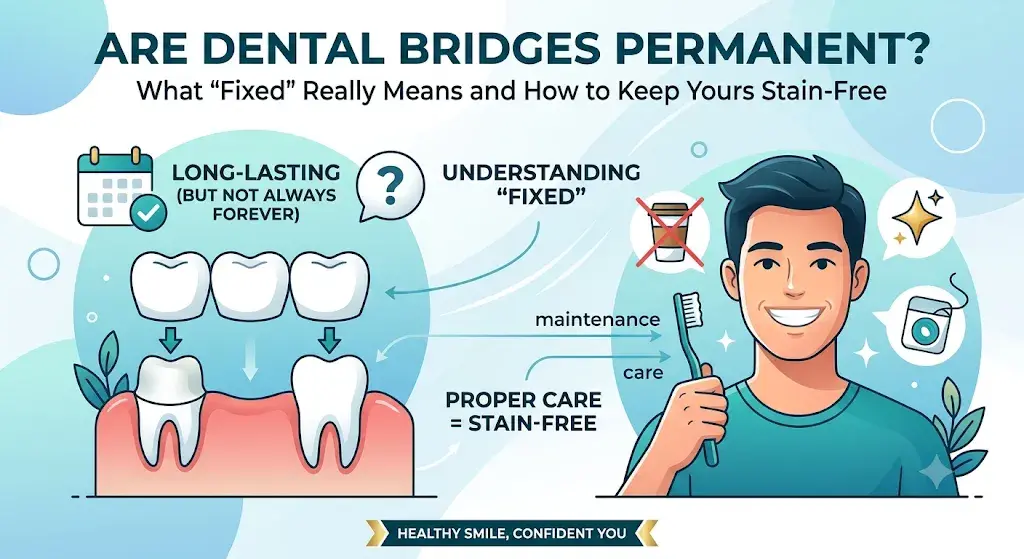
Are Dental Bridges Permanent?
A fixed dental bridge is cemented onto your supporting teeth or implants, so only a dentist can remove it. However, it is not permanent for life. Bridges are long-term restorations that commonly last many years, but they can eventually wear, loosen or need replacing, depending on the health of the teeth and gums that support them.
That’s the key distinction. “Permanent” in dentistry usually means non-removable, as opposed to a removable partial denture that you take out nightly. It doesn’t mean indestructible.
What “Fixed” Actually Means
A dental bridge replaces one or more missing teeth by anchoring an artificial tooth (the pontic) to the teeth or implants on either side of the gap. Once your dentist cements the final bridge, you brush and clean it in place. You don’t take it out at night, soak it or pop it in and out for meals.
How fixed a bridge is depends on its design:
| Bridge type | How it’s held | How permanent it is |
| Traditional | Crowns cemented over the teeth on both sides of the gap | Fixed; removed only by a dentist, usually by sectioning it |
| Cantilever | Crown cemented on one side only | Fixed, but more stress on a single supporting tooth |
| Maryland (resin-bonded) | Metal or ceramic wings bonded to the backs of neighbouring teeth | Fixed, but the bond can loosen more easily, so it’s mostly used for front teeth |
| Implant-supported | Anchored to dental implants | Fixed; many designs are the most stable option |
Two practical points follow from this. First, if your bridge feels loose, don’t try to push it back or glue it yourself. Over-the-counter adhesives can trap bacteria under the restoration and make it harder for your dentist to re-seat it properly. Second, when a traditional bridge does need to come out, your dentist often has to cut through it. That’s why a bridge is considered a long-term decision rather than something you can casually undo.
Why a “Permanent” Bridge Still Needs Attention
A bridge is only as strong as what’s holding it. Several things can shorten its working life even though the bridge material itself can’t decay:
- The supporting teeth. Decay or gum disease in the anchor teeth is a common reason bridges fail, because the cement seal at the edge of each crown can let bacteria in.
- The cement. Over time the bond can weaken, which may allow a bridge to loosen.
- The gum tissue. Plaque that builds up beneath the pontic can inflame the gums and, over time, affect the bone supporting your teeth.
- Your bite. Clenching or grinding puts extra load on the restoration. A nightguard can help.
How long this takes varies widely from person to person. We cover typical timelines in detail in our guide on how long dental bridges last, and if you’re still deciding between options, our comparison of dental implants vs dental bridges walks through how each approach holds up over time.
What’s Normal After Getting a Dental Bridge?
Many patients worry in the first weeks because the bridge feels different. Some of that is expected. Here’s what we generally consider normal and what deserves a call.
Usually normal:
- The bridge feels bulky or slightly unfamiliar for the first few days while your tongue and cheeks adjust.
- Mild sensitivity to hot or cold in the supporting teeth, especially after tooth preparation.
- Gum tenderness around the edges for a short period after the bridge is placed.
- A slight change in how you pronounce certain sounds, which tends to settle as you adapt.
Worth a call to your dentist:
- Your bite feels “high,” as if the bridge hits first when you close. This is easily adjusted, and leaving it can cause soreness.
- Sensitivity or pain that is getting worse instead of settling.
- A bridge that feels loose or shifts when you touch it.
- A persistent bad taste or odour, which can point to trapped plaque or decay underneath.
- Swelling or bleeding gums that don’t improve with careful cleaning.
If you’re unsure about eating in the early days, our posts on eating with a dental bridge and what you can eat normally cover which foods to ease into.
How to Remove Stains From a Dental Bridge
Here’s something many people don’t expect: the porcelain or zirconia on a bridge resists staining better than natural enamel, but it isn’t stain-proof. Surface film, tartar at the gumline, and the natural teeth beside the bridge can all pick up colour, which can make the bridge look darker or mismatched.
Quick steps to lift surface stains safely:
- Brush gently twice a day with a soft-bristled brush and a non-abrasive fluoride toothpaste, angling the bristles toward the gumline.
- Clean under the pontic daily with a floss threader, super floss or interdental brush, since stained plaque tends to collect where you can’t see it.
- Rinse with water after coffee, tea, red wine or cola to reduce how long stain-causing drinks sit on the surface.
- Book a professional cleaning. Hygienists can polish away surface stain and remove tartar that home brushing can’t, using methods safe for dental restorations.
- Ask about the margins. If dark lines appear where the bridge meets the gum, have it checked rather than scrubbing at it, since that can indicate decay or a gap in the seal.
What to avoid:
- Abrasive “whitening” toothpastes, charcoal products and baking-soda scrubbing. These can dull the glazed surface of porcelain, which makes it hold stain more easily over time.
- At-home whitening kits aimed at the bridge itself. Whitening gels change natural enamel, not ceramic or porcelain, so they won’t lighten a bridge.
- Heavy scrubbing with stiff brushes. It irritates gums and can wear the restoration’s surface.
Whitening and Bridges: Plan the Order
Because a bridge won’t change colour, the sequence matters. If you want your natural teeth brighter, professional teeth whitening is best done before the bridge is made, so the shade can be matched to your whitened teeth. Whitening afterwards can leave the bridge looking darker than the teeth around it. If you’ve already got a bridge and are considering whitening, speak to your dentist first, and if sensitivity is a concern, see our guide to whitening for sensitive teeth.
Best Mouthwash for Dental Bridges
No mouthwash will keep a bridge clean on its own. It supports brushing and flossing; it doesn’t replace them. When choosing one, a few features matter more than the brand name:
- Fluoride. A daily fluoride rinse helps protect the natural teeth under and beside the bridge, where decay most often begins. This is the single most useful feature for bridge wearers.
- Alcohol-free. Alcohol can leave your mouth feeling dry, and a dry mouth tends to collect more plaque. Alcohol-free formulas are gentler on gums, especially if they’re sensitive after treatment.
- Independent endorsement. Look for the Canadian Dental Association’s Seal of Recognition on the label as a sign the product has been reviewed.
A caution on prescription-strength antibacterial rinses. Chlorhexidine rinses are useful for short-term gum problems, but prolonged use can cause brown surface staining on teeth and restorations. Use them only if your dentist recommends them, and only for the period they advise. Some over-the-counter antibacterial rinses can cause mild staining too, so if you notice new discolouration, mention it at your next visit.
How to use it: Rinse after brushing and flossing (or at a different time of day if your toothpaste and rinse are different fluoride products, as your dentist or hygienist may suggest), swish for the time shown on the label, and avoid eating or drinking for a short while afterwards so the fluoride can work.
For the full step-by-step routine, including floss threaders and water flossers, see our guide on how to clean a dental bridge.
Cost, “Cheap” and “Discount” Bridges: What to Know
Many people searching for a permanent bridge are also comparing prices. A few honest points:
- Bridge pricing varies with materials, the number of units and whether preparation work is needed. Our dental bridge cost guide breaks down typical ranges and financing options.
- The BC Dental Association publishes an annual suggested fee guide, but dentists aren’t required to follow it, so quotes differ between practices. Ask for an itemized estimate.
- The lowest upfront quote isn’t always the lowest long-term cost. A poorly fitted bridge can fail early, so fit, materials and the health of the supporting teeth matter as much as price.
Dental Bridges Near You in Abbotsford
If you’re searching for dental bridges near you, the most useful first step is a consultation. We examine the gap, check the health of the neighbouring teeth and gums, take X-rays where needed, and talk through whether a bridge, an implant or another option suits your situation and budget. If a crown is part of your treatment, we’ll explain how that fits too.
You can also read our earlier guide on the 2-2-2 rule for dental bridges and crowns for a simple way to remember checkup and care habits.
Frequently Asked Questions
Can a dentist remove a dental bridge and put it back?
Sometimes a bridge can be taken off and re-cemented if it has simply loosened and the supporting teeth are healthy. Often, though, a traditional bridge has to be cut apart to remove it, and a new one is made. Your dentist can tell you which applies after examining it.
Can I whiten a dental bridge?
No. Whitening products work on natural enamel, not porcelain or ceramic. Surface stains can be polished off professionally, but the underlying shade of the bridge won’t change.
Can a dental bridge come loose?
Yes. Worn cement, decay in a supporting tooth or heavy biting forces can loosen a bridge. Stop using that side, avoid sticky foods, and book an appointment promptly. Don’t use household glue.
Are Maryland bridges permanent?
They’re fixed in place, but they rely on bonding rather than full crowns, so the bond can release more easily than a traditional bridge. Your dentist will advise whether this design suits the tooth being replaced.
Do I need to take my bridge out to clean it?
No. A fixed bridge stays in. Clean under it daily with a floss threader, interdental brush or water flosser.
The Bottom Line
So, are dental bridges permanent? They’re fixed, meaning only your dentist can remove them, and they’re built to last for years. But they’re not forever, and how long yours holds up depends heavily on the teeth and gums underneath and on daily care. Keep up with cleaning, use a fluoride mouthwash, avoid abrasive stain-removal tricks and see your dentist regularly.
If you have a question about a bridge you already have, or you’re considering one, the team at Medora Dental Care in Abbotsford is happy to help. Call us at (604) 746-1295 or contact us to book a consultation at 110-1910 N Parallel Rd, Abbotsford, BC.
This article is for general information and isn’t a substitute for personalized dental advice. Your dentist can assess your specific situation.