
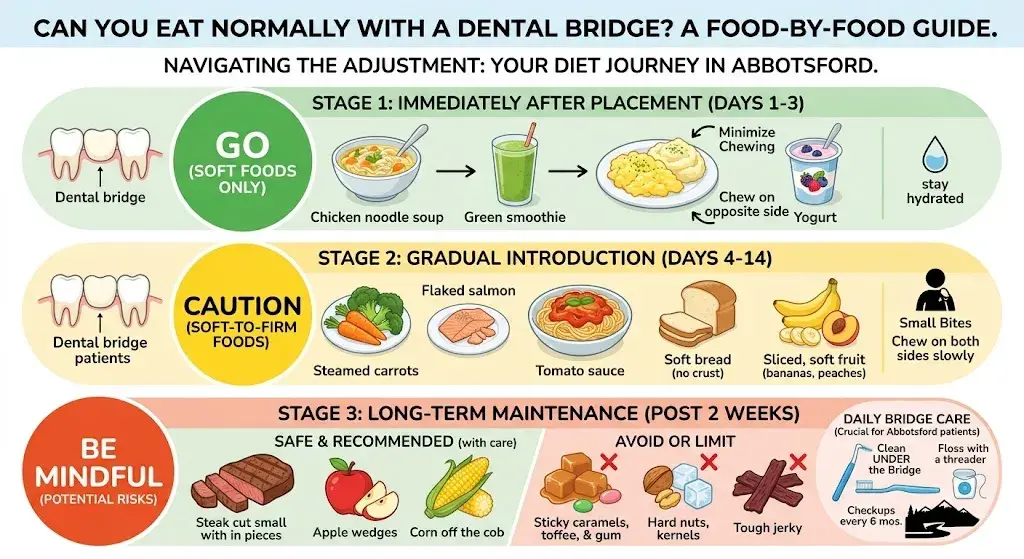
Quick answer: Yes, you can eat normally with a dental bridge. Most Abbotsford patients return to their regular diet within two to four weeks of getting a dental bridge, once the abutment teeth settle and they get used to chewing with the new restoration in place. During the first few days, sticking to softer foods helps protect the bridge while the cement fully sets and any sensitivity fades.
That’s the short version. But “normal” doesn’t mean the same thing for a steak dinner as it does for a bowl of soup, and a lot of patients want a straight answer about specific foods before they bite down and risk damaging a restoration they just paid for. Below, we’ll walk through exactly what you can eat and when, which foods to be careful with long-term, and how to tell the difference between normal adjustment and a bridge that needs attention.
How a Dental Bridge Affects Chewing
A dental bridge replaces one or more missing teeth with an artificial tooth (called a pontic) held in place by crowns on the healthy teeth on either side (the abutment teeth). Because the bridge is cemented in and doesn’t move, it functions much closer to a natural tooth than a removable denture does — you don’t need to worry about it shifting mid-bite the way you might with a partial.
That said, dental bridges’ effect on chewing isn’t zero. The bite force travels through the abutment teeth instead of through a natural root, which is why your dentist reshapes those teeth and caps them with crowns in the first place — to spread the load safely. This is also why very hard or very sticky foods deserve more caution with a bridge than they would with a full set of natural teeth.
How Long Does It Take for a Dental Bridge to Feel Normal?
Most patients notice their bridge starting to feel normal within one to two weeks, with full adjustment — including chewing confidently on both sides of the mouth — by the four-week mark. A few things happen during this window:
- Days 1–3: The anesthetic wears off, the cement finishes setting, and the bite is still new. Minor sensitivity in the abutment teeth is common.
- Week 1: Speech and saliva production normalize. You’ll likely still favor the opposite side when chewing.
- Weeks 2–4: Most patients stop noticing the bridge is there and return to their usual foods.
- 6–8 weeks: Full settling, especially if the bridge involved an extraction beforehand.
If it’s been longer than 6–8 weeks and your bridge still doesn’t feel right, that’s worth a call to your dentist rather than waiting it out.
Can You Eat With a Dental Bridge? Specific Foods, Answered
Here’s where most guides stay vague. These are the exact foods patients ask us about most, answered directly.
Can you eat steak with a dental bridge?
Yes, once your bridge has settled (generally after the first 2–4 weeks). Cut it into smaller pieces and chew slowly on both sides rather than tearing at it with your front teeth. Very tough or fibrous cuts are harder on any bridge, natural teeth included, so this is more about technique than restriction.
Can you chew gum with a dental bridge?
It’s best to avoid gum, especially in the early weeks. Chewing gum is sticky enough to pull at the pontic or work its way under the edges of the crowns, which can loosen the cement over time. If you chew gum regularly, sugar-free gum in moderation is lower-risk than caramel-style chews, but it’s still not ideal long-term.
Can you eat chips with a dental bridge?
Yes, chips are generally fine once you’re past the initial adjustment period. They’re crunchy but not hard in the way ice or nuts are. The main thing to watch for is sharp edges or shards getting caught around the bridge — rinse or floss afterward.
How long after a dental bridge can you eat hot food?
Wait until the local anesthetic has fully worn off, usually a few hours, so you don’t accidentally burn your mouth without feeling it. After that, hot food is fine, though very hot temperatures can cause brief sensitivity in the abutment teeth during the first week or two while they settle.
Can you chew with a dental bridge the same way as a natural tooth?
Mostly, yes — that’s the point of the restoration. Implant-supported bridges tend to feel closest to a natural tooth, while traditional and cantilever bridges may need slightly more care on the bridge side until you’re fully adjusted.
Foods to Eat Right After Getting a Dental Bridge
For the first few days, lean on foods that require minimal chewing:
- Smooth soups, broths, and mashed potatoes
- Scrambled eggs, yogurt, and cottage cheese
- Well-cooked pasta and soft rice
- Smoothies and protein shakes
- Soft fruits like bananas and cooked or canned peaches
As comfort improves over the following one to two weeks, gradually add in shredded meats, steamed vegetables, and softer breads before working back up to your full diet.
Foods to Be Careful With Long-Term
Even after your bridge has fully settled, a few categories are worth ongoing caution — not because they’re forbidden, but because they’re the most common cause of bridge damage:
- Very hard foods: ice, hard candy, unpopped popcorn kernels, whole nuts
- Sticky foods: caramel, taffy, chewing gum, dried fruit
- Extreme temperatures: very hot or very cold food and drink, especially back-to-back
None of these mean you have to give up the food entirely — cutting hard foods smaller, chewing on your stronger side, and enjoying sticky treats occasionally rather than daily all go a long way toward protecting your bridge for the 10–15 years or more it’s designed to last.
Tips for Eating Comfortably With a Bridge
- Cut food into smaller, manageable pieces, especially in the first month
- Chew evenly across both sides of your mouth rather than favoring the bridge
- Avoid biting directly into hard or fibrous foods with your front teeth
- Rinse with water after meals to clear debris from around the pontic
- Keep up with regular brushing and flossing under the bridge to prevent decay in the abutment teeth
When Eating Feels Wrong: Signs to Call Your Dentist
Some adjustment is expected, but a few symptoms mean it’s time to get your bridge checked rather than wait it out:
- Persistent pain or pressure when chewing, beyond the first couple of weeks
- The bridge feels loose, shifts, or moves when you bite
- A gap opens up between the bridge and your gumline
- Food consistently gets trapped in the same spot no matter how you clean it
- A bad taste or odor that doesn’t go away with brushing
If your bridge does come loose or dislodge, don’t try to eat around it — contact your dentist promptly, or reach out to our emergency dentistry team if it happens outside regular hours.
Bridge vs. Implant: Does One Chew Better Than the Other?
If you’re still deciding between a bridge and an implant, chewing function is one of the biggest differentiators. Implant-supported restorations are anchored directly into the jawbone, so they typically deliver bite strength closest to a natural tooth from day one. Traditional bridges rely on your existing teeth and generally need that adjustment window before they feel fully natural. You can compare the two in more detail on our dental bridges vs. dental implants page, or ask about it during a consultation — your bone health, budget, and timeline all factor into which option makes more sense for you.
FAQs: Eating and Chewing With a Dental Bridge
Can you eat normally with a dental bridge?
Yes. Most people return to a normal diet within 2–4 weeks of placement, once the abutment teeth settle and the bite feels familiar.
Can you eat with a dental bridge the same day it’s placed?
Yes, but wait until the anesthetic fully wears off, and stick to soft foods for the first 24 hours to avoid biting your cheek or tongue by accident.
Is it normal for a dental bridge to feel strange when eating at first?
Yes. A slightly “foreign” feeling in the first one to two weeks is normal and typically fades as your tongue and bite adjust.
What foods should you avoid with a dental bridge?
Very hard foods like ice, nuts, and hard candy, along with sticky foods like caramel and chewing gum, carry the highest risk of damaging or loosening a bridge.
Do dental bridges affect chewing on both sides of your mouth equally?
Once fully adjusted, yes — a properly fitted bridge should let you chew evenly on both sides without favoring one over the other.
Get Your Bridge Checked in Abbotsford
If you’re missing one or more teeth and want a fixed, natural-feeling way to eat and chew with confidence again, our Abbotsford restorative team can walk you through whether a dental bridge is the right fit. And if you already have a bridge that isn’t feeling or functioning the way it should, don’t wait — contact Medora Dental Care or call (604) 746-1295 to get it looked at.