
Quick answer: Yes, dentists routinely extract infected teeth, and in many cases removing the tooth is exactly what stops the infection from spreading further. Depending on how far the infection has progressed, your dentist may prescribe antibiotics before or after the procedure, and recovery is usually similar to a standard extraction — just monitored a little more closely.
Finding out you need a tooth extraction is stressful enough. Finding out the tooth is infected on top of that raises a whole new set of questions: Is it even safe to pull an infected tooth? Will the infection get worse during the procedure? What if it comes back afterward? This guide walks through the entire process — from recognizing the warning signs to what a safe recovery looks like — so you know exactly what to expect.
If your pain is severe right now and you’re trying to decide whether this qualifies as a dental emergency, our 24/7 emergency extraction guide covers what to do in the first hour before you can reach a dentist. This article focuses specifically on infection — what causes it, how it’s treated, and how to recover safely.
Can You Get a Tooth Extracted While It’s Infected?
Yes. It’s a common misconception that a tooth needs to be infection-free before it can be removed — in reality, extraction is one of the most direct ways to resolve a dental infection, because it eliminates the source rather than just treating the symptoms. When a tooth is severely decayed or the infection has destroyed too much of the root, extraction alongside drainage of the abscess is often the fastest way to relieve pain and stop the infection from spreading to surrounding tissue.
The exception is when swelling has spread significantly into the face, jaw, or neck (a condition called cellulitis). In these cases, a dentist may prescribe a course of antibiotics first to bring the swelling down before performing the extraction, simply because operating on heavily swollen, inflamed tissue is more difficult and can affect how well local anesthetic works.
Signs Your Tooth Infection Needs Emergency Extraction
Not every infected tooth requires same-day treatment, but certain symptoms mean you shouldn’t wait:
- Severe, throbbing pain that doesn’t respond to over-the-counter pain relievers
- Visible swelling in the face, cheek, or jaw
- A persistent bad taste or smell, which often indicates a draining abscess
- Fever or general feeling of illness alongside tooth pain
- Pain that radiates to your ear, neck, or the side of your head
- Difficulty fully opening your mouth or swallowing
If you experience difficulty breathing, swallowing, or swelling that is rapidly spreading toward your eye or down your neck, treat this as a medical emergency — go to your nearest emergency room or call 9-1-1 rather than waiting for a dental appointment. These are rare but serious signs the infection may be spreading beyond what a dental office alone can safely manage.
Is It Safe to Extract an Infected Tooth?
Yes, when performed by a licensed dentist under proper conditions. The procedure follows the same sterile protocol as any extraction, with a few infection-specific adjustments:
- The abscess is drained during the procedure, relieving pressure and pain almost immediately
- The socket is thoroughly irrigated to remove infected tissue
- Additional anesthetic or a nerve block may be used, since infected, acidic tissue can make standard local anesthetic less effective
- Antibiotics may be prescribed afterward to clear any remaining bacteria
The bigger risk usually comes from delaying treatment rather than from the extraction itself — an untreated infection doesn’t resolve on its own and typically continues spreading.
Do You Need Antibiotics Before an Infected Tooth Extraction?
It depends on how contained the infection is. For a localized infection confined to the tooth and immediate surrounding gum tissue, many dentists proceed directly to extraction and draining the abscess, since removing the source of infection is often more effective than antibiotics alone. Antibiotics are more commonly prescribed beforehand when there’s visible facial swelling, fever, or signs the infection is spreading beyond the tooth itself.
This is a clinical judgment your dentist makes based on an exam, and sometimes imaging, so it’s not something to self-diagnose. If you’re currently taking antibiotics for a dental infection, mention this at your appointment along with when you started them and how you’ve been feeling since.
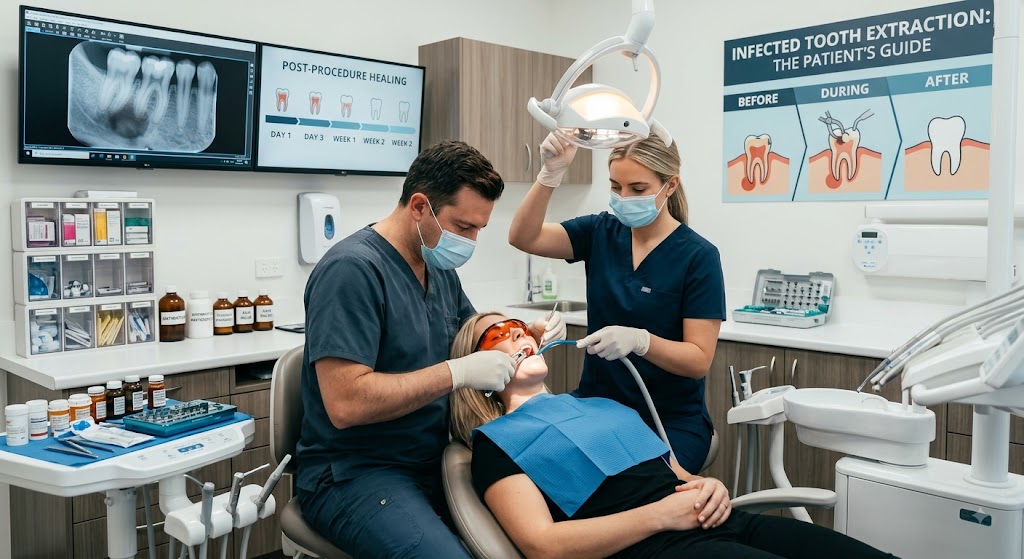
What Happens During an Infected Tooth Extraction?
The step-by-step process is similar to a standard extraction, with extra attention paid to the infected site:
- Examination and imaging (X-ray or CBCT scan) to assess how far the infection has spread and confirm the tooth can’t be saved
- Local anesthetic, sometimes supplemented with additional numbing agents to fully manage sensation in infected tissue
- Careful removal of the tooth, followed by draining and cleaning the abscess pocket
- Irrigation of the socket to flush out infected material
- Placement of gauze, and in some cases a small drain or dissolvable packing, to support healing
- Clear aftercare and, if appropriate, an antibiotic prescription to finish clearing the infection
You can find a full walkthrough of the general extraction process, including sedation options, on our tooth extraction page.
Emergency Tooth Extraction: When It Can’t Wait
If your infection came on suddenly, with rapidly increasing pain or swelling, this may qualify as a true dental emergency rather than a routine extraction. Our emergency dentistry team and our same-day emergency appointment guide outline how quickly you can typically be seen and what same-day treatment looks like. The short version: most dental offices, including ours, prioritize same-day or next-day appointments for active infections, precisely because delay increases risk.
Tooth Infection After Extraction: Is That Normal?
This question comes up constantly, and the honest answer is: some inflammation is completely normal, but true infection after extraction is not, and the two are easy to confuse.
In the first 2–3 days after any extraction, mild swelling, tenderness, and slight redness around the socket are a normal part of healing — your body is doing exactly what it should. This typically peaks around day 2 or 3 and then steadily improves.
Dry Socket vs. Infection: What’s the Difference?
Patients often assume worsening pain a few days after extraction means infection, but the more common cause is dry socket — when the blood clot protecting the extraction site dislodges too early, exposing the bone underneath. Dry socket causes sharp, throbbing pain (often radiating to the ear) around day 3–5, but it isn’t an infection and doesn’t typically involve fever, pus, or spreading swelling. True infection tends to involve those additional systemic signs, not just localized pain.
Signs of Infection After Tooth Extraction
Contact your dentist the same day if you notice any of the following after an extraction:
- Swelling that gets worse after day 3, rather than improving
- Pus or discharge from the extraction site
- A fever that develops or persists more than a day or two after treatment
- A foul taste or odor that doesn’t improve with gentle rinsing
- Pain that intensifies rather than gradually easing after the first few days
- Difficulty swallowing or opening your mouth fully
Post-extraction infection is uncommon when aftercare instructions are followed, but it can happen — especially if the original infection was extensive, or if the socket wasn’t kept clean during healing.
How to Prevent Infection After a Tooth Extraction
- Take the full course of any prescribed antibiotics, even if you start feeling better partway through
- Gently rinse with warm salt water starting 24 hours after the procedure to keep the area clean without disturbing the healing clot
- Avoid smoking, straws, and vigorous rinsing or spitting for at least the first few days, since these can dislodge the clot and increase infection risk
- Keep up gentle brushing everywhere except directly on the extraction site
- Attend any follow-up appointment your dentist schedules, particularly after an infected extraction
For a full breakdown of what to eat while your socket heals, see our guide on foods to eat after a tooth extraction.
If an Infection Spreads: A Rare but Serious Risk
In very rare cases, an untreated or worsening dental infection can spread into deeper tissues of the face, neck, or, extremely rarely, the bloodstream. Warning signs include rapidly increasing facial swelling, swelling that affects your ability to swallow or breathe, a high fever, or feeling generally unwell alongside worsening dental symptoms. This is a medical emergency — go to the nearest emergency room immediately rather than waiting for a dental appointment. These cases are uncommon, but they’re the reason dentists take facial swelling and fever seriously rather than treating every infection the same way.
Recovery Timeline for an Infected Tooth Extraction
- Days 1–2: Peak swelling; pain typically eases quickly since the infection source has been removed
- Days 3–5: Swelling steadily decreases — also the window to watch for dry socket if pain suddenly worsens
- Week 1–2: Soft tissue closes over the socket; any prescribed antibiotics should be finished
- Weeks 3–6+: Deeper healing continues, and your dentist may discuss replacement options once infection has fully resolved
Recovery can feel slower in the first couple of days compared to a routine extraction, simply because there was more inflammation to begin with — but the trajectory should still be steady improvement, not worsening symptoms.
Replacing a Tooth After an Infected Extraction
Once the infection has fully cleared and your dentist confirms the site has healed, you’ll likely want to discuss replacement options to restore full function and prevent shifting of neighbouring teeth. Dental implants are the most common long-term solution, though your dentist will typically wait until the infection has completely resolved and the bone has had time to heal before starting implant planning.
If you’re still unsure whether extraction was the right call versus saving the tooth with treatment, our comparison of root canal vs. extraction walks through how that decision is made, and our root canal treatment page explains when saving the tooth is still possible.
Frequently Asked Questions
Can a dentist pull an infected tooth?
Yes. Extraction is a standard and often necessary treatment for an infected tooth, especially when the infection has destroyed too much of the tooth structure to save it. Removing the tooth also removes the source of the infection.
Is emergency tooth extraction painful if the tooth is infected?
The procedure itself shouldn’t be painful, since local anesthetic (sometimes with additional numbing for infected tissue) is used throughout. Many patients report feeling significant relief almost immediately after an infected tooth is removed, since the pressure from the abscess is released.
How long does swelling last after an infected tooth extraction?
Swelling typically peaks around day 2–3 and steadily improves over the following week. If swelling is getting worse after day 3 rather than better, contact your dentist — that pattern can indicate the infection hasn’t fully cleared.
Can infection come back after a tooth extraction?
It’s uncommon when aftercare instructions and any prescribed antibiotics are followed completely, but it can happen, particularly if the original infection was extensive or the socket becomes contaminated during healing. Watch for pus, worsening swelling, or fever, and contact your dentist promptly if they appear.
Do you always need antibiotics for an infected tooth extraction?
Not always. For infections that are well-contained to the tooth itself, extraction and drainage alone are often sufficient. Antibiotics are more commonly used when there’s facial swelling, fever, or signs the infection is spreading beyond the immediate area. Your dentist will determine this based on your exam.
When to See a Dentist Right Away
If you’re currently dealing with a painful, swollen, or infected tooth, the safest step is a same-day evaluation rather than waiting to see if it improves on its own — dental infections don’t resolve without treatment, and early evaluation almost always means a simpler, more comfortable procedure.
Contact Medora Dental Care or call (604) 746-1295 to book an urgent appointment. Dr. Ash and our Abbotsford team will assess whether the tooth can be saved or needs extraction, and walk you through exactly what to expect at every step.