
Mild soreness is normal at day 5, 6 or 7 after a tooth extraction, but pain that is getting worse instead of better is not. If your pain peaked around day 3 and has been easing, you are healing normally. If severe, throbbing pain starts or returns between days 3 and 7, especially with a bad taste or a visible empty socket, you may have dry socket and should see a dentist promptly.
That is the short answer, and it is where most people searching for “tooth extraction pain after 7 days” need to start. This guide explains what normal healing feels like day by day, how dry socket differs, what else can cause late pain, and what you can safely do at home while you wait for your appointment.
If you had a tooth extraction in Abbotsford or a wisdom tooth removed and something feels wrong, you do not have to guess. Our team at Medora Dental can see you quickly. Read on, then call us if any warning sign below matches what you feel.
Key takeaways
- Pain should peak in the first 2–3 days, then slowly fade. By day 5–7 it is usually a dull ache or tenderness.
- Dry socket typically shows up 2–4 days after extraction. It causes intense pain that over-the-counter medication barely touches.
- Fever, swelling that spreads, or pus point to infection, not dry socket. Both need a dentist.
- Treatment is quick. A dentist can usually relieve dry socket pain at the same visit.
What Is Normal Pain After a Tooth Extraction on Day 5, 6 and 7?
Normal healing has a clear direction: each day should feel a little better than the one before. Your body forms a blood clot in the empty socket right after the tooth comes out. That clot protects the bone and nerves underneath while new tissue grows in.
Here is what most people notice:
- Day 1–2: The worst stretch. Expect soreness, some swelling, and light oozing of blood.
- Day 3: Swelling and discomfort usually peak, particularly after wisdom teeth removal.
- Day 5: Pain should be clearly lower. You may feel a dull ache, jaw stiffness, or tenderness when you chew near the site.
- Day 6: Tooth extraction day 6 often feels like a mild, intermittent soreness. Bruising on the cheek can still be visible and may even look yellow or green as it fades.
- Day 7: Many people need little or no pain medication. The gum edges begin to close, and dissolvable stitches, if you have them, may start to loosen.
You may also see a white or yellowish layer in the socket. That is usually granulation tissue, which is part of healing, not pus. If you want the full timeline, our guide to tooth extraction healing stages walks through each phase from the first hour to full bone healing.
Recovery length varies. Lower wisdom teeth, impacted teeth and surgical extractions usually take longer than a simple extraction. Our wisdom tooth removal recovery guide covers those timelines in detail.
The key test: if pain is slowly improving, even if it is not gone, that is the normal pattern. If it is flat, rising, or comes back after a few good days, treat that as a warning sign.
What Is Dry Socket and When Does It Start?
Dry socket, called alveolar osteitis in clinical terms, happens when the blood clot in the extraction site is dislodged or dissolves too early. Without that clot, the bone and nerve endings in the socket are exposed to air, food and fluids. That exposure causes the deep, aching pain people describe as worse than the extraction itself.
Timing matters. Dry socket usually begins 2–4 days after the extraction, often just as the first few days of soreness should be fading. Many people feel fine on day 2, then wake up on day 4 or 5 with pain that climbs. The pain can continue through days 5, 6 and 7 until it is treated, which is why late pain deserves attention.
How common is it? Dry socket affects a small share of routine extractions, commonly quoted at around 2–5%. The risk rises noticeably after lower wisdom tooth removal, especially impacted teeth.
Who is at higher risk?
- People who smoke or vaporize, because suction and chemicals disturb the clot
- Anyone who uses a straw, spits forcefully or rinses hard in the first days
- Patients with a history of dry socket after a previous extraction
- Difficult or surgical extractions, particularly lower wisdom teeth
- People with an existing infection around the tooth or poor oral hygiene
- Some people taking estrogen-containing birth control, so tell your dentist about your medications
Dry socket is painful, but it is not dangerous in itself, and it is very treatable. The danger lies in waiting weeks with untreated pain.
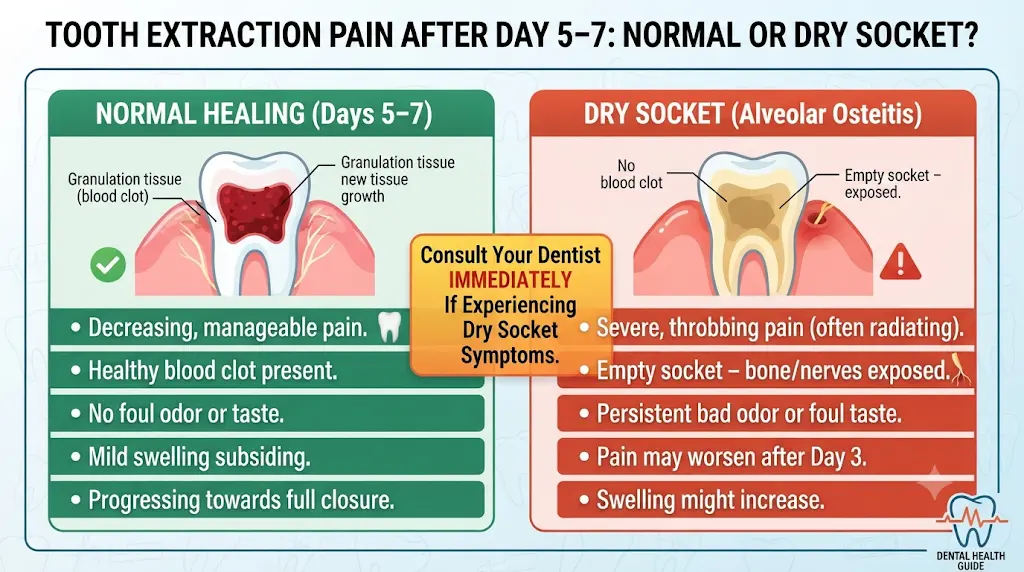
Dry Socket vs Normal Healing: How to Tell the Difference
Use this table as a quick check. It is a guide, not a diagnosis, because only a dentist can look inside the socket.
| Sign | Normal healing (day 5–7) | Possible dry socket |
|---|---|---|
| Pain trend | Easing day by day | Worsening, or returns after improving |
| Pain level | Mild to moderate ache | Severe, throbbing, hard to ignore |
| Response to pain medication | Controlled with over-the-counter options | Little or no relief |
| Pain spread | Stays near the site | Radiates to ear, temple, eye or neck on the same side |
| Look of the socket | Pink gum edges, whitish or yellowish tissue | Looks empty, with pale or whitish bone visible |
| Taste and smell | Normal, or a faint metallic taste early on | Bad taste or foul odour in the mouth |
| Swelling | Fading | Little swelling (more swelling and fever suggest infection) |
| Eating and sleeping | Gradually easier | Pain interrupts sleep and chewing |
If your symptoms sit mostly in the right-hand column, call a dentist the same day. You can also read our guide on what to do when tooth pain is unbearable, and see why toothache pain is often worse at night when it keeps you awake.
Other Reasons for Pain or Sore Gums After a Tooth Extraction
Not every late ache is dry socket. If your gums are sore after tooth extraction and the pattern does not fit, consider these causes:
- Infection: Spreading swelling, a fever, pus, a persistent bad taste, or pain that grows after day 3–5 can mean infection. This needs a dentist and sometimes antibiotics. Our infected tooth extraction guide explains how to recognize it.
- Bone fragments or a sharp ridge: Small bone pieces can work their way to the surface in the first weeks. They feel like a hard splinter under the gum and may irritate the tongue or cheek.
- Food trapped in the socket: Food debris can cause soreness and a bad taste. Gentle rinsing helps, but do not dig at it.
- Sinus involvement (upper molars): A tooth root can sit close to the sinus. Pressure, nasal congestion, or fluid or air passing between mouth and nose after an upper molar extraction needs prompt review.
- Nerve irritation (lower wisdom teeth): Tingling, numbness or an altered feeling in the lip, chin or tongue should be reported. Most cases improve, but your dentist should know.
- Jaw muscle soreness: Opening wide during the procedure can leave the jaw muscles stiff and achy for a week or more.
- Pain from a neighbouring tooth: The tooth next to the extraction site can feel sensitive while the area heals.
If you are unsure which one applies, that is a good reason to be seen, not to wait.
What to Do at Home While You Wait for Your Appointment
These steps can ease discomfort and protect the site. They do not replace a dental exam if you suspect dry socket.
- Take pain relief as directed. Use the over-the-counter medication your dentist or pharmacist recommended, and follow the label. Check with them first if you take blood thinners or have stomach, kidney or liver conditions.
- Use a compress. Cold packs help during the first 48 hours. After that, a warm compress against the cheek can ease jaw stiffness.
- Rinse gently. After the first 24 hours, a mild saltwater rinse helps keep the area clean. Let the water fall out of your mouth instead of spitting. Our article on why skipping saltwater rinses can be dangerous explains the technique.
- Eat soft, lukewarm food. Yogurt, eggs, soup, mashed potatoes and smoothies (with a spoon, not a straw) are good choices. See our list of foods to eat after tooth extraction and when it is safe to eat solid food after tooth extraction.
- Sleep with your head raised. An extra pillow reduces throbbing.
- Avoid smoking, vaping and alcohol. They slow healing and can disturb the clot.
What not to do: do not poke the socket with a finger, toothpick or tongue, do not place aspirin directly on the gum, and do not rely on home remedies for severe pain. If you are already struggling, read our full guide on what to do when tooth pain is unbearable.
When to Call a Dentist and How Dry Socket Is Treated
Call your dentist the same day if you notice:
- Severe or worsening pain between days 3 and 7, or pain that returns after improving
- A socket that looks empty, with bone showing
- A bad taste or odour that rinsing does not clear
- Pain spreading to your ear, temple or neck
- Pain that medication does not control or that stops you sleeping
- Numbness or tingling that does not fade
Seek emergency care immediately if you have swelling that spreads to your eye, neck or floor of the mouth, difficulty swallowing or breathing, a high fever, or bleeding that does not stop after 20–30 minutes of firm pressure. In BC, go to the nearest emergency department or call 911 for breathing or swallowing problems.
For urgent dental pain, our team can often arrange a same-day emergency dental appointment in Abbotsford. You can also review our emergency dentistry services or our 24/7 emergency extraction guide.
How dentists treat dry socket
Treatment is usually simple and brings fast relief:
- The dentist examines the site and may take an X-ray to rule out other causes.
- The socket is gently cleaned and flushed to remove debris.
- A medicated dressing is placed in the socket to soothe the exposed bone and protect it.
- You receive pain management advice and aftercare instructions.
- The dressing may be changed once or twice until symptoms settle. Antibiotics are only used when there is an infection.
Many patients feel noticeably better soon after the dressing goes in. Full healing then continues as normal. If you feel nervous about a dental visit while in pain, ask about sedation dentistry in Abbotsford options.
How to Prevent Dry Socket After a Tooth Extraction
You cannot remove every risk, but good aftercare cuts it a lot. In the first week:
- Follow your dentist’s written aftercare instructions exactly
- Do not smoke, vape or use straws, and avoid spitting or swishing hard
- Keep to soft foods and chew on the opposite side
- Brush your other teeth gently and keep the area clean with careful rinsing
- Avoid strenuous exercise for the first couple of days
- Tell your dentist before the procedure about smoking, medications and any past dry socket
Good planning helps too. If you are considering replacing the missing tooth, discuss it at your extraction visit. Options such as dental implants in Abbotsford or dental bridges are easier to plan when the extraction site heals well. If a wisdom tooth is the problem, our guide to what happens if wisdom teeth are not removed explains why timing matters, and everything you need to know about wisdom teeth covers the basics.
Frequently Asked Questions
Is it normal to have tooth extraction pain after 7 days?
Mild tenderness at day 7 is normal, especially after wisdom teeth removal. Pain that is severe, worsening, or returning after it had improved is not normal and should be checked by a dentist.
How do I know if I have dry socket or normal pain?
Normal pain eases steadily and responds to over-the-counter medication. Dry socket causes intense, throbbing pain that often radiates to the ear, comes with a bad taste or smell, and may show visible bone in the socket. A dentist can confirm it with a quick exam.
Can dry socket happen after 5 days?
It usually starts 2–4 days after extraction, but pain from a dislodged clot can appear or still be present on day 5, 6 or 7. Late onset is less common, so also consider infection or other causes.
Can I eat pizza on day 6 after wisdom teeth removal?
Often yes, if it is soft, not very hot, and you chew on the other side. Avoid hard crusts and sharp edges that can catch in the socket. Check with your dentist if you had surgical removal or still have significant pain. See our guide on how soon you can eat after wisdom teeth removal.
Why are my gums still sore after a tooth extraction?
Gums can stay tender for one to two weeks while the tissue closes over the socket. Soreness that is increasing, or comes with swelling, pus or fever, needs a dental visit.
Will dry socket heal on its own?
It can eventually, but healing is slow and painful without treatment. Seeing a dentist for a medicated dressing is the fastest way to get relief.
Get Relief From Extraction Pain in Abbotsford
Pain at day 5, 6 or 7 should be getting better. If it is not, or if it suddenly gets worse, do not wait it out. Dry socket and infection are both treatable, and early care means less pain and a faster recovery.
Medora Dental in Abbotsford provides tooth extractions, wisdom teeth removal and urgent emergency dental care for patients in Abbotsford and nearby areas. Contact us today to book an exam and get your recovery back on track.
This article is general information and does not replace professional dental advice. If you have severe pain, swelling or trouble breathing or swallowing, seek care right away.