
Missing teeth can affect not only your smile but also your confidence, speech, and ability to chew properly. Fortunately, modern dentistry offers reliable and long-lasting solutions through dental implants. Understanding the types of dental implants is essential before choosing the right treatment for your oral health needs.
In this detailed guide, we will explain the most common dental implant types explained, including single tooth dental implant, multiple tooth implants, and the widely discussed All-on-4 dental implants technique. We will also explore procedures, costs, benefits, and who is eligible for each option.
Whether you are replacing one tooth or considering full-mouth restoration, this guide will help you understand all tooth replacement options implants in a clear and practical way.
What Are Dental Implants Types?
Before exploring the types of dental implants, it is important to understand what dental implants are.
A dental implant is a titanium post surgically placed into the jawbone to replace the root of a missing tooth. Once healed, a crown, bridge, or denture is attached to restore function and appearance.
There are different dental implant procedure types depending on how many teeth need replacement and the condition of the jawbone.
The most common types of dental implants include:
- Single Tooth Dental Implant
- Multiple Tooth Implants
- Full Mouth Dental Implants (All-on-4 system)
Each option serves a different purpose depending on the severity of tooth loss.
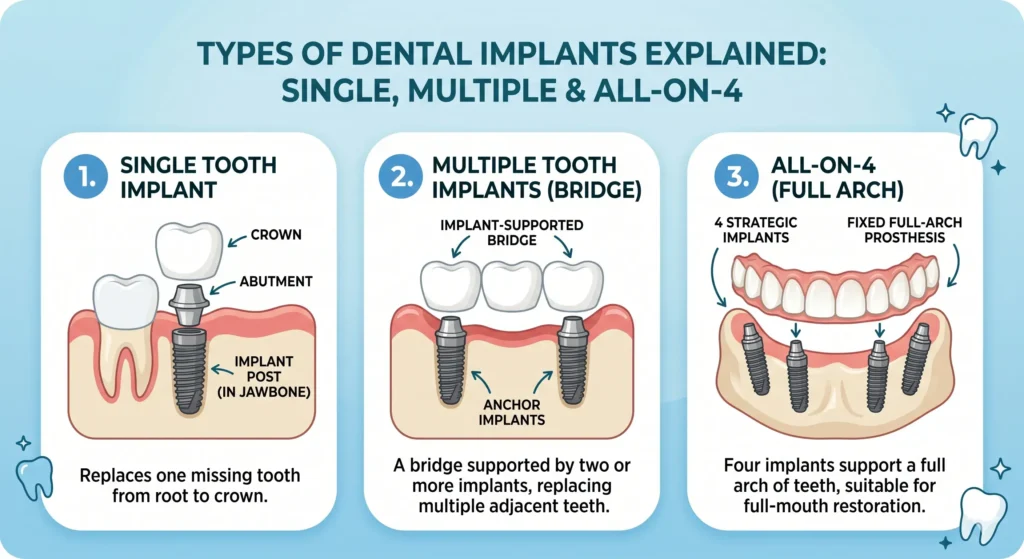
1. Single Tooth Dental Implant
A single tooth dental implant is the most basic and common form of implant treatment. It is used when only one tooth is missing.
How it works
- A titanium implant is placed into the jawbone
- After healing, a crown is attached
- It functions like a natural tooth
Benefits
- Preserves surrounding teeth
- Looks and feels natural
- Prevents bone loss
- Long-lasting solution
Best for
- Patients missing only one tooth
- Healthy jawbone condition
Many patients compare single tooth implant vs bridge which is better, and implants are often preferred because they do not affect adjacent teeth.
2. Multiple Tooth Implants
When more than one tooth is missing but not the entire arch, multiple tooth implants are recommended.
How it works
Instead of placing an implant for every missing tooth, dentists strategically place 2–4 implants to support a bridge.
This is also known as an implant supported bridge.
Benefits
- Replaces several teeth efficiently
- More stable than removable dentures
- Preserves jawbone health
- Cost-effective compared to individual implants
Difference between single and multiple implants
The main difference between single and multiple dental implants is the number of teeth being restored and the structure used. Single implants replace one tooth, while multiple implants support a group of teeth.
3. All-on-4 Dental Implants
The All-on-4 dental implants system is one of the most advanced solutions in modern dentistry. It is designed for patients who have lost most or all teeth in one arch.
All-on-4 dental implants explained step by step
- Four implants are placed in the jaw
- Two are placed vertically in the front
- Two are angled at the back for support
- A full arch prosthetic bridge is attached
This creates a fixed set of teeth supported by only four implants.
Benefits of All-on-4
- Immediate full-mouth restoration
- No need for individual implants per tooth
- Strong and stable results
- Often avoids bone grafting
- Faster recovery compared to traditional methods
All-on-4 vs traditional implants
When comparing All-on-4 vs traditional implants, traditional methods may require 6–8 implants per arch, while All-on-4 uses only four strategically placed implants, reducing cost and treatment time.
Who is eligible for All-on-4 dental implants?
You may be a candidate if you:
- Have multiple missing teeth
- Suffer from severe tooth decay
- Have reduced bone density
- Want a fixed alternative to dentures
Many patients ask if All-on-4 dental implants are worth it, and for full-mouth restoration, they are often considered one of the most efficient solutions.
Full Mouth Dental Implants Options
When it comes to replacing all teeth, patients usually consider full mouth dental implants.
There are two main approaches:
1. All-on-4 system
- Uses 4 implants per arch
- Fixed prosthetic teeth
2. Implant-supported dentures
- Uses more implants (6–8)
- Removable or fixed denture options
Both fall under full arch dental implants, but All-on-4 is more commonly chosen due to speed and affordability.
Best Option for Replacing Multiple Missing Teeth
Choosing the best dental implant options depends on your oral health condition.
- One missing tooth → Single implant
- Several missing teeth → Multiple implants or implant bridge
- Entire arch missing → All-on-4 or full mouth implants
Your dentist will evaluate jawbone strength, gum health, and overall oral condition before recommending treatment.
Fixed vs Removable Dental Implants
Another important comparison in types of dental implants is whether the restoration is fixed or removable.
Fixed implants
- Permanently attached
- Feel like natural teeth
- No daily removal needed
Removable implants (overdentures)
- Can be removed for cleaning
- More affordable
- Less stability compared to fixed options
Most patients prefer fixed solutions for comfort and confidence.
Cost of Different Dental Implant Types
The cost of different dental implant types varies based on complexity and number of implants.
General cost factors include:
- Number of implants required
- Bone grafting needs
- Type of restoration (crown, bridge, denture)
- Dentist expertise and location
Approximate comparison:
- Single implant → Most affordable
- Multiple implants → Moderate cost
- All-on-4 → Higher upfront cost but cost-effective for full mouth
While cost is important, long-term durability should also be considered.
Dental Implant Surgery and Procedure Types
Understanding dental implant surgery helps patients prepare for treatment.
Steps involved
- Consultation and X-rays
- Bone evaluation
- Implant placement surgery
- Healing period (osseointegration)
- Crown or prosthetic attachment
In some cases, bone graft for dental implants may be required if jawbone density is low.
Modern techniques have made implant surgery highly safe and predictable.
Titanium Dental Implants and Material Strength
Most implants are made from titanium dental implants, known for:
- High durability
- Biocompatibility
- Strong integration with bone
Titanium allows implants to fuse naturally with the jawbone, ensuring long-term stability.
Jawbone Health and Missing Teeth Treatment Options
When teeth are missing, jawbone deterioration can occur over time. Dental implants help maintain jawbone health and implants work together to prevent bone loss.
Other missing teeth treatment options include:
- Dental bridges
- Removable dentures
- Partial dentures
However, implants are the only solution that actively preserves bone structure.
Full Mouth Restoration with Dental Implants Options
A full mouth restoration with dental implants options includes:
- All-on-4 system
- All-on-6 implants
- Implant-supported dentures
Each method restores function, appearance, and confidence for patients with severe tooth loss.
Conclusion
Understanding the types of dental implants is essential when deciding the best treatment for missing teeth. Whether you need a single tooth dental implant, multiple tooth implants, or a full arch solution like All-on-4 dental implants, each option offers unique benefits.
The right choice depends on your oral condition, budget, and long-term goals. While single implants are ideal for isolated tooth loss, All-on-4 provides a complete smile restoration with fewer implants and faster results.
Consulting a dental professional will help determine the most suitable tooth replacement options implants for your specific needs.